
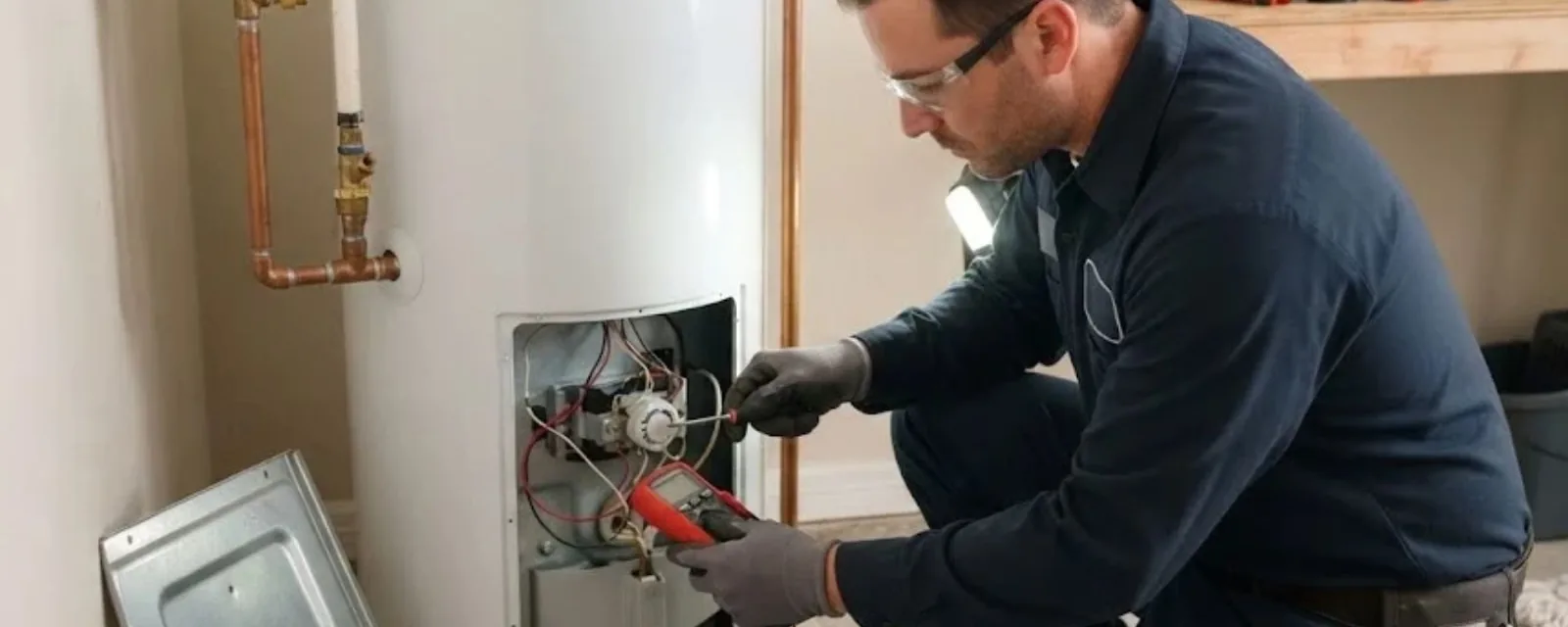
No hot water on a cold morning is an emergency to the people living in the house, even when nothing is flooding. If the tank itself is leaking from the bottom, skip the repair and plan on water heater replacement instead. If the heater is warm, noisy or hot only briefly, there is a good chance a smaller part has failed.
Our plumber checks the heater the way a mechanic checks an engine, one system at a time. Gas units are tested for the pilot, thermocouple or flame sensor and gas control valve. Electric units are tested for power, thermostats and heating elements. You get the findings and the price before any part is replaced.
First checks you can safely make
Before calling, confirm that the breaker has not tripped or that the gas valve at the heater is open. Press the reset button on an electric unit only once. If you smell gas, do not light anything, leave the home and call 911 or your gas utility, then call us after it is safe. These checks take two minutes and sometimes save a service call.
Do not do these
- Do not relight a pilot repeatedly if it will not stay lit.
- Do not remove access panels on an electric unit with the breaker on.
- Do not plug a leaking relief valve. It is a safety device.
- Do not ignore a rotten-egg smell near a gas heater.
What fails, and what it takes to fix it
Most repairs fall into a short list. A thermocouple or flame sensor wears out and the pilot will not stay lit. A heating element burns out, which leaves an electric tank with lukewarm water. A thermostat sticks, a relief valve drips, or a dip tube cracks so cold water mixes into the hot outlet. Each has a different fix and a different cost.
| Symptom | Common cause | Typical repair |
|---|---|---|
| Pilot will not stay lit | Worn thermocouple or sensor | Replace the sensor, clean the burner |
| Lukewarm water, electric | Failed lower element | Replace the heating element |
| Hot water runs out quickly | Cracked dip tube or sediment | Replace dip tube, flush the tank |
| Water at relief valve discharge | High pressure or failed valve | Test pressure, replace valve, check expansion |
| Popping or rumbling noises | Sediment on the tank floor | Flush the tank |
Water heater acting up?
Call and we will find the failed part and tell you whether repair or replacement makes more sense.
When repairing stops making sense
A repair is worth it when the tank is sound and the part is cheap relative to the heater's remaining life. It stops being worth it when the tank is leaking, rust is showing in the water, or the heater is old enough that another part will fail within a year.
Our plumber will tell you directly if the numbers favor a swap, and you can decide with the cost of both in front of you.
Local conditions that shape repairs
Local water from Sunrise Water Authority is soft, so you will rarely see the thick scale that kills heating elements in hard-water cities. That helps. It also means a sediment complaint in a Happy Valley tank often points to a worn anode rod or aging tank rather than mineral buildup, and the repair advice changes with the cause.
Many homes here have the heater in a garage, a closet or an attic space. Access matters for a repair, and the plumber will tell you if the location changes the price. A heater with a worn drain pan or missing seismic straps can also get a safety upgrade during the visit.
Pricing a water heater repair
The price depends on the part, the labor and the model. Common repairs like replacing an element or a thermocouple are quoted before the plumber starts. If testing shows the repair is bigger than expected, the plumber stops, explains the new information and lets you choose. You will not be handed a surprise bill after the work is done.
What to do before the plumber arrives
- For a gas smell, leave the home and call 911 or your gas utility before calling us.
- If the tank is leaking, close the cold water supply valve on top of the heater.
- Turn the gas control to pilot or off, or switch off the electric heater at its breaker.
- Do not touch a relief valve discharge pipe, because the water can scald.
Relief valves, discharge piping and bracing are covered by the Oregon Plumbing Specialty Code (OPSC), which is based on the Uniform Plumbing Code (UPC).
Water heater repair questions
Without heat in winter or with kids and elderly residents at home, yes. A leaking tank is more urgent because water damage grows quickly. Shut off the cold supply, switch off power or gas, and call.
The usual causes are a worn thermocouple or flame sensor, a dirty burner, a draft problem or a failing gas control valve. The plumber tests each before replacing anything.
On electric tanks that is usually a failed lower element or a bad thermostat. On gas tanks it can be a weak burner or a cracked dip tube. Testing tells us which.
A leak from a fitting, valve or drain can often be repaired. A leak from the tank body means the liner has failed and the heater needs replacing.
Yes. It may be reacting to high pressure or temperature, or the valve itself has failed. Do not cap it. Call us so it can be tested and replaced if needed.
Yes. See our tankless water heater page for installation, flushing and service of those units.